




Introduction: Why Pulley Selection and Maintenance Matter
Pulleys may be simple in concept, but in industrial applications, choosing the right one can make the difference between smooth operation and unexpected downtime. Whether driving a conveyor, tensioning a fan belt, or lifting a multi-ton load, industrial pulleys remain essential components of modern power transmission.
This guide covers the most common power-transmission pulley types used in today’s equipment and explains how to select the right pulley for your system.
From Simple to Industrial: The Evolution of Pulleys
Traditional pulley systems—fixed, movable, and block-and-tackle—form the foundation for nearly all modern pulley designs. These early configurations redirected force or multiplied lifting power, principles still applied today in cranes, hoists, and other material-handling equipment.
Modern drive pulleys build on those same fundamentals, applying them to power transmission instead of lifting. In a drive system, a sheave mounted on a motor or power source turns a flexible element—such as a belt, rope, or chain—which then rotates another sheave to transfer motion, torque, or speed.
In essence, a drive pulley operates on the same principle as a basic pulley—only instead of lifting a load, it drives another shaft. This simple yet effective design enables smooth power transfer across countless industrial systems.
Today’s drive pulleys are engineered for precision speed control, efficient torque transmission, and long service life under continuous load. Understanding the different drive pulley types and their roles helps maintenance professionals diagnose problems quickly and select the right components for reliable performance.
Common Industrial Driven Pulley Types
Drive pulleys come in a variety of designs, each optimized for specific applications, loads, and operating conditions. While they all serve the same basic function—transmitting motion and torque between shafts or belts—their construction and surface features vary to match the job.
Typically, when you think of a drive pulley, you are referring to a motor with a drive sheave that is rotating a belt that attaches to another sheave. But technically, a conveyor system is also a type of drive pulley system. It just changes how it moves the load slightly.
Below, we’ll talk about the most common types of pulleys (sheaves) used in industrial power transmission and material-handling systems.
Drive Sheave (Drive Pulley)

The drive pulley is the powered component in a belt drive system. It’s connected to the motor and transmits motion to the belt, which in turn drives the equipment’s secondary shaft or conveyor.
In heavy-duty applications such as conveyors or crushers, drive pulleys are often coated with rubber lagging to improve traction and wear resistance.
Idler & Take-Up Pulleys

Idler pulleys guide or tension a belt, but don’t transmit power. They help maintain proper wrap angle, reduce vibration, and prevent belt flutter. Idler pulleys are used in both belt and conveyor systems.
Take-up pulleys, a special type of idler, maintain belt tension automatically through adjustable mounts, springs, or counterweights.
Lagged Pulley
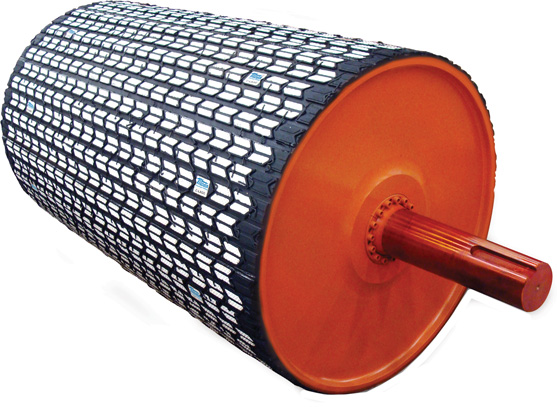
A lagged pulley is a drive pulley coated with rubber or ceramic material to increase grip between the pulley and the conveyor belt. Lagging improves traction, reduces slippage, and protects the pulley shell from wear—especially in high-torque or dirty environments like mining, aggregates, or bulk material handling.
Pulley lagging is most commonly used on drum pulleys in conveyor systems and is rarely seen on belt sheaves. Typically, drive sheaves (pulleys) are either V-belts or synchronous belts, replacing the need for lagged sheaves on standard power transmission pulleys.
Step Pulley and Variable Pitch Pulley

Step pulleys have multiple diameters stacked together, allowing operators to change belt position and adjust speed manually. Variable pitch pulleys use adjustable flanges to fine-tune the effective diameter without stopping the machine—useful for HVAC systems, blowers, and other equipment requiring flexible speed control.
Timing and Synchronous Pulleys (Sprockets)

Timing pulleys (also called synchronous sheaves or sometimes sprockets) have toothed grooves that mate precisely with matching timing belts. This positive-drive design eliminates slippage and ensures accurate, synchronized motion between shafts—making it the go-to choice for robotics, conveyors, and precision machinery. Because power is transmitted through tooth engagement rather than friction, timing pulleys deliver high efficiency and positional accuracy.
Flat Belt Pulleys

Flat belt pulleys have a smooth or slightly crowned surface that drives a flat belt. They operate on the principle of surface friction—power is transmitted by the grip between the belt and the pulley face. Because they run quietly and handle high speeds efficiently, flat belts are often used in older line-shaft systems, textile machinery, and low-torque applications.
The slight crown on a flat pulley helps keep the belt centered during operation without flanges or side guides. However, because flat belts can slip under heavy load or contamination, they are less common in modern heavy-duty systems.
V-Belt Pulleys

V-belt pulleys (also called V-sheaves) have a grooved profile shaped like a “V” that matches the belt’s trapezoidal cross-section. The sides of the belt wedge into the groove, increasing friction and power transmission efficiency as tension rises. This self-tightening effect allows V-belts to transmit higher torque in a compact design without slipping.
V-belt pulleys are used extensively in industrial drives for fans, pumps, conveyors, and compressors. They’re available in multiple standard profiles (A, B, C, D, SPA, SPB, SPC, etc.), and many are designed with tapered bushings for easy installation and removal. Multi-groove pulleys can run two or more belts in parallel for greater power capacity.
Real-World Applications of Drive Pulleys
Drive pulleys are at the heart of most industrial motion systems. Whether powering a fan, moving a conveyor, or driving a pump, they convert motor energy into usable mechanical motion. Here’s where different types of drive pulleys are commonly used across modern facilities:
HVAC Fans and Blowers
Most HVAC systems use V-belt drive pulleys to connect motors and fans. A motor sheave drives a larger fan pulley, allowing simple speed adjustments by changing pulley diameters or using adjustable-pitch sheaves. This arrangement isolates the motor from fan vibration and makes it easy to fine-tune airflow for system balance or efficiency.
HVAC applications often favor cast iron or steel pulleys for strength and durability under continuous operation, while adjustable-pitch designs provide flexibility during setup.
Conveyor Systems
Conveyors are one of the most common examples of drive pulley systems in industry. Typically, a motor drives a gearbox with a V-belt. The gearbox then turns the head pulley, which then powers the conveyor belt.
The conveyor belt itself features lagging pulleys and idler pulleys, but isn’t typically considered a drive pulley system by itself, despite its similarities to one.
Pumps, Compressors, & Industrial Machinery
Drive pulleys are essential in rotating equipment such as pumps, compressors, and blowers. They allow speed and torque to be adjusted simply by changing pulley diameters—a small motor pulley driving a larger pump pulley slows the pump and increases torque.
V-belt pulleys are most common here due to their compact design and strong grip under high load. Some precision machinery, such as packaging lines or automation systems, may use timing pulleys and synchronous belts for exact speed control without slippage.
Machine Tools and Shop Equipment
Many machine tools—drill presses, lathes, and mills—use step pulleys or variable-pitch pulleys to change spindle speed quickly without swapping components. By moving the belt from one step to another, operators can adjust RPMs to suit material type or cutting depth.
This simple mechanical control remains widely used because it’s durable, predictable, and easy to maintain.
Agricultural and Mobile Equipment
Drive pulleys also appear in tractors, harvesters, and mobile industrial systems. They power secondary functions such as fans, augers, or hydraulic pumps. In these settings, V-belt or flat-belt drives are valued for flexibility, easy field maintenance, and the ability to absorb shock loads that might otherwise damage gear drives.
Choosing the Right Pulley for Your System
Selecting the proper pulley for an industrial application is crucial for both performance and longevity. When choosing a pulley (sheave) for your system, consider several key factors, including the pulley’s size, the groove profile (to match your belt or cable), and the material/construction of the pulley. Each of these factors should align with the demands of your specific application:
Pulley Size (Diameter & Ratio)

Pulley size directly affects speed, torque, and belt or rope life. In a power transmission setup, the ratio between pulley diameters determines how fast or slow the driven shaft rotates.
The speed ratio is calculated as:
Speed Ratio = Diameter of Driven Pulley ÷ Diameter of Driver Pulley
For example, if a 4-inch motor pulley drives an 8-inch fan pulley, the fan will rotate at half the motor speed but with about twice the torque—similar to a gear reduction effect.
When sizing pulleys, consider both performance and mechanical limits:
- Speed ratio: Choose diameters that deliver the desired output speed and torque. Rim speed on cast iron above 6,500 feet per minute typically require special balancing or alternative materials.
- Minimum bend radius: Avoid pulleys that are too small. A smaller pulley forces the belt or rope to bend sharply, increasing stress and wear. Every belt and wire rope has a minimum recommended pulley diameter to prevent premature fatigue. For example, a 7×19 steel cable typically requires a sheave at least 25 times the cable diameter to prevent strand breakage.
- Efficiency trade-offs: Very large pulleys reduce bending stress and improve efficiency but may be impractical due to space or cost. In most cases, use the largest pulley that fits your design to minimize wear and energy loss.
- Wrap angle: In multi-pulley systems, ensure sufficient belt contact (wrap angle) on the drive pulley for adequate friction. Too little contact can cause slipping, heat buildup, and power loss.
In summary, pulley sizing is a balance between mechanical advantage, efficiency, and durability. Always verify manufacturer data for minimum pulley diameters and speed ratios.
Groove Type and Belt/Cable Compatibility

Pulleys are machined with specific groove profiles for specific belts or ropes. Matching the groove to the belt/cable is non-negotiable for grip, life, and safety.
- V-belts → Use V-groove pulleys with the correct section (A, B, SPA, SPB, etc.) so the belt seats at the flank, not bottoming out, and maintains frictional contact.
- Timing/synchronous belts → Use toothed timing pulleys that match the belt profile and pitch (e.g., HTD, GT2).
- Flat belts → Use flat pulleys, often with a slight crown to aid tracking.
- Round belts/ropes → Use round or U-shaped grooves.
- Wire ropes → Use U- or V-shaped grooves; some elevator applications use Philadelphia grooves.
The difference between a timing pulley and a V-belt pulley comes down to how they transmit power: timing pulleys use toothed grooves for precise, no-slip synchronization, while V-belt pulleys rely on friction between the belt and groove sidewalls for smooth, high-torque power transmission.
Using the wrong groove type causes slippage (if too loose) or accelerated wear (if too tight or mismatched). Never run a flat belt on a V-grooved pulley or a cable on a pulley designed for a belt.
If you need greater power capacity, consider multi-groove sheaves that run multiple belts in parallel. In synchronous drives, confirm the pulley pitch diameter matches the belt pitch; in V-belt drives, check that the belt fits the pulley’s effective diameter.
Material and Construction
Pulley material determines strength, wear resistance, and environmental suitability. Each type has trade-offs:
- Cast iron: Strong, durable, and ideal for heavy industrial loads; heavier mass increases rotational inertia, providing smoother operation but slower acceleration.
- Steel: High strength and ductility, allowing thinner, lighter designs; used in engines, fans, and high-speed drives.
- Aluminum: Lightweight and corrosion-resistant—excellent for damp environments or mobile systems, though softer unless hard-coated.
- Engineered polymers/composites: Lightweight, self-lubricating, and non-corrosive; suited for light-duty or food-grade applications but limited by heat and load.
Match the pulley material to the operating environment. High heat or oil exposure favors metals or engineered polymers; corrosive or washdown settings may require stainless steel or plastics.
Mounting note: Most industrial pulleys use QD-style or split taper bushings for easy installation and secure shaft connection. Always verify bore size and keyway compatibility when replacing or specifying a pulley.
For high RPM applications, ensure pulleys are dynamically balanced to minimize vibration. When speed and precision are critical, aluminum or balanced steel pulleys are often considered the best pulley materials for high-speed drives, combining light weight with excellent stability.
Additional Selection Factors
- Flanges and guards: Timing pulleys typically require flanges to keep belts aligned.
- Drive vs. idler role: Idlers may use different bearings or surface finishes for smooth freewheeling.
- Load and safety factor: Lifting or tensioned applications must meet rated load requirements.
- Speed flexibility: If you need to adjust speed without changing components, use a step pulley or variable-pitch pulley.
Matching Pulley Type to Application
Here are some examples of which types of pulleys might work best with which applications.
| Application | Recommended Pulley Type | Key Benefits |
| HVAC systems | V-belt pulleys with adjustable-pitch sheaves | Fine-tune airflow and motor load |
| Conveyors | Lagged cast-iron drive pulley with steel idlers | High traction, reduced belt slip |
| Precision machinery | Aluminum or steel timing pulleys | Synchronous, slip-free drive |
| Outdoor or corrosive settings | Stainless steel or polymer pulleys | Corrosion resistance, long life |
| Shop tools | Step or variable-pitch pulleys | Manual or adjustable speed control |
Common Mistakes When Selecting Pulleys
Be careful of making one of these common mistakes when choosing which pulley to use:
- Using a pulley smaller than the belt’s minimum recommended diameter
- Mixing incompatible belt sections (A with SPA, B with SPB, etc.)
- Ignoring alignment or wrap angle during design or installation
- Forgetting to specify dynamic balance for high-speed applications
Putting It All Together to Choose the Right Pulley
Selecting the right pulley means aligning three core factors—size, groove profile, and material—with your system’s speed, torque, and environmental demands.
For example, a heavy-duty crusher might use a large, ductile or steel drive pulley to handle high tension and abrasive conditions. In contrast, a precision CNC axis would use small, balanced aluminum timing pulleys for accuracy and low inertia.
The wrong choice can lead to belt slippage, premature wear, or mechanical failure. Always consult engineering data, verify belt and pulley compatibility, and ensure correct shaft mounting. A well-chosen pulley delivers efficient power transmission, reduced maintenance, and long-term reliability.
Need help putting together a pulley system that works for your application? Call the knowledgeable sales team at IBT Industrial Solutions, and we’ll help you find the products you need.
Brand Spotlight: MasterDrive™ PT Components — Precision You Can Rely On

When it comes to power transmission, precision and reliability make all the difference. That’s where industrial drive pulleys from MasterDrive PT Components™, a leading brand from Solve Industrial Motion Group, set the standard.
MasterDrive specializes in high-quality sheaves, bushings, and couplings engineered to keep industrial systems running at peak efficiency.
Every component MasterDrive produces is built for performance and durability — from heavy-duty cast iron and ductile iron sheaves to machined steel couplings and precision-balanced drive components. Their products are designed to meet or exceed industry standards for torque capacity, alignment accuracy, and vibration control. This focus on tight tolerances ensures smoother operation, longer belt life, and reduced maintenance downtime.
MasterDrive’s extensive product line covers everything from standard V-belt sheaves and taper-lock bushings to QD-style hubs, variable pitch pulleys, and timing belt sprockets. Each part is backed by Solve Industrial Motion Group’s commitment to consistent quality, rapid availability, and expert technical support — a combination maintenance professionals value when uptime is critical.
For maintenance teams who demand consistent performance from their power transmission systems, MasterDrive sheaves and bushings from Solve Industrial Motion Group deliver proven reliability. MasterDrive components embody the same precision engineering and simplicity that make pulley systems indispensable to modern industry.

Shop MasterDrive PT Online today!
Check out ShopIBT.com to find the bearing and power transmission products for your needs!
